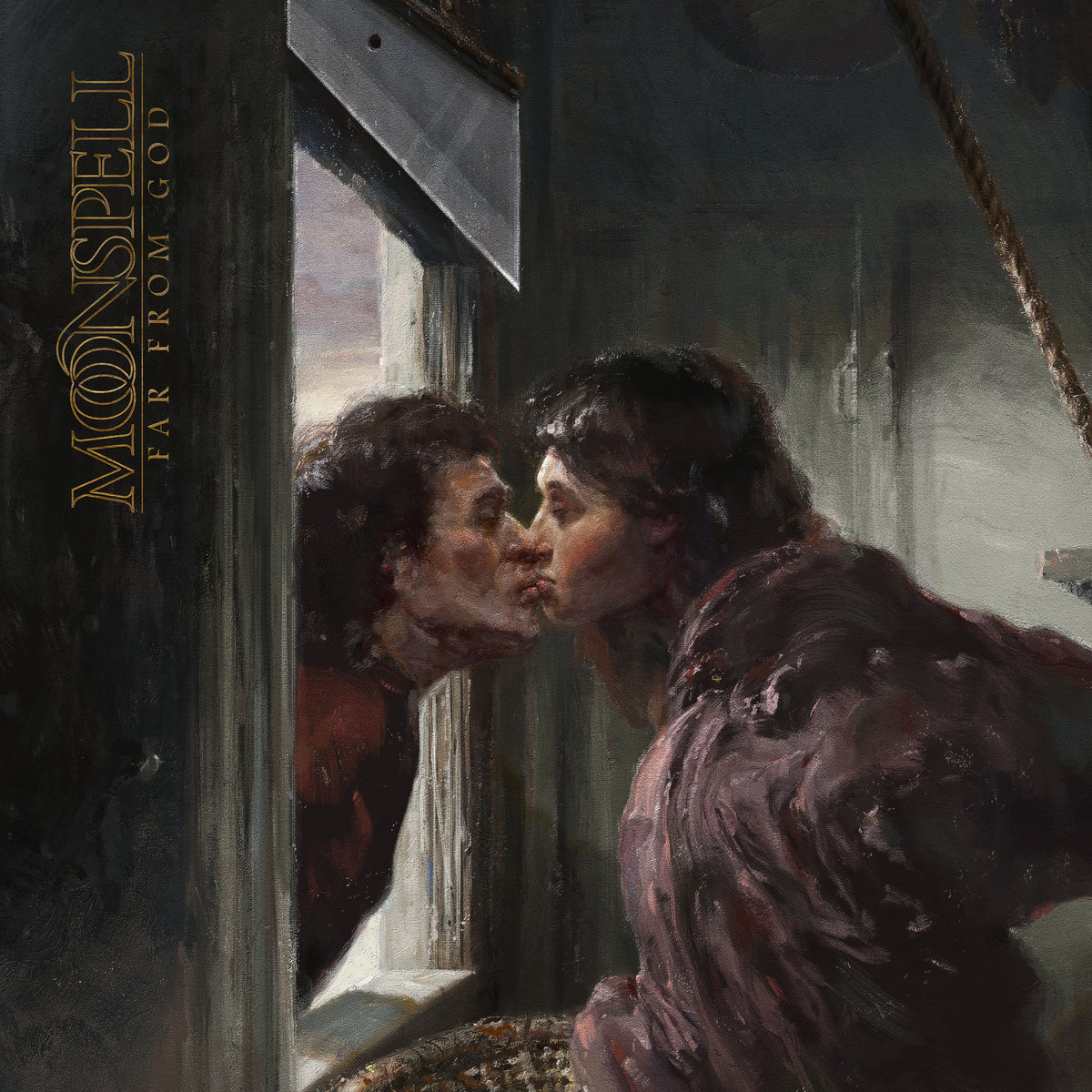
Released in 2021, in the midst of the pandemic, Moonspell’s previous album, the excellent Hermitage, never really got the live treatment it deserved, like so many other records released at the time and its birth was almost its funeral. As if to make up for it, the Portuguese band has nevertheless released two live albums since then… but Moonspell doesn’t do things by default: the first was recorded in a cave 80 metres underground in front of a small audience, whilst the second, by contrast, featured a full symphony orchestra! Fernando Ribeiro readily admits that the last few years haven’t been easy, as inspiration has been hard to come by… and as we’ve said, Moonspell don’t make music “by default”. Far From God is billed as “a modern Irreligious”, a return to a certain simplicity but also to a more gothic tone.
There are signs that leave no room for doubt. Less technically convoluted than Hermitage or even 1755, Far From God prioritises emotion and impact right from the very start. With Cross Your Heart, Moonspell skilfully manipulates light and shadow: whilst darkness is certainly essential, they know that to see it, you must also shed light! Without any grand gestures and eschewing a triumphant opening, this restrained start to the album may come as a surprise. Yet it will make sense when viewed as a whole, for the band never repeats itself; on the contrary, they maintain a steady build-up of tension.
Nuance, elegance – Ribeiro’s warm, clear voice takes on a deep melancholy whilst the rhythms veer towards post-punk – something that is even more striking on the title track. Moonspell also takes us back a little to the era of the instantly memorable melodies of Extinct, where every track is a hit, but with a more atmospheric approach: the spectral synths creeping through The Great Wolf in the Sky, for example, are particularly effective.
If you’re expecting any violet tremors, they’ll come only sparingly – as in the few roars of Biblical, the very heavy and menacing Our Freedom to Fall, or the epic finale Reconquista, during which Moonspell unleash their black horses to paint an intense apocalyptic picture as the album’s grand finale. The effects are meticulously crafted to amplify their power tenfold. Before that, the focus is on dark romanticism, vampiric references (Ribeiro, a narrator-crooner more cursed than ever, was deeply impressed by Eggers’ Nosferatu), and a solemnity that blends the sacred, mourning, creatures of the night and poetry. Gothic in all its flamboyance, its weightiness and its theatrical grandeur fuels the aesthetic and world of Far From God, as well as its musical direction (in addition to that post-punk bass, the shadows of Paradise Lost or Type O Negative lurks unmistakably).
Moonspell made a wise choice in moving towards simpler compositions, leaving more room not only for the stories told by their singer but also for the listener. The Portuguese band leave plenty of space for contemplation and introspection (For the Love of Mortals) and steer clear of any over-the-top flourishes or grandiose orchestration. That, too, is what elegance and talent are all about: having enough confidence to know when not to overdo it, much like the guitars that step back just enough to give the bass a space it fills perfectly.
Right up to its triumphant conclusion, Far From God is a model of mastery and conciseness, in which nostalgia for Moonspell’s masterpieces of gothic metal is elevated through experience and craftsmanship that prevents the message from becoming diluted or watered down, whilst also ensuring it does not descend into kitsch gimmicks. Far From God contains everything it needs, presented in just the right way, in the right order, with nothing out of place, nothing overdone, and with precision in the lyrics, the atmospheres and the compositions: Moonspell hesitated, had their doubts, but ultimately found grace simply by being Moonspell.