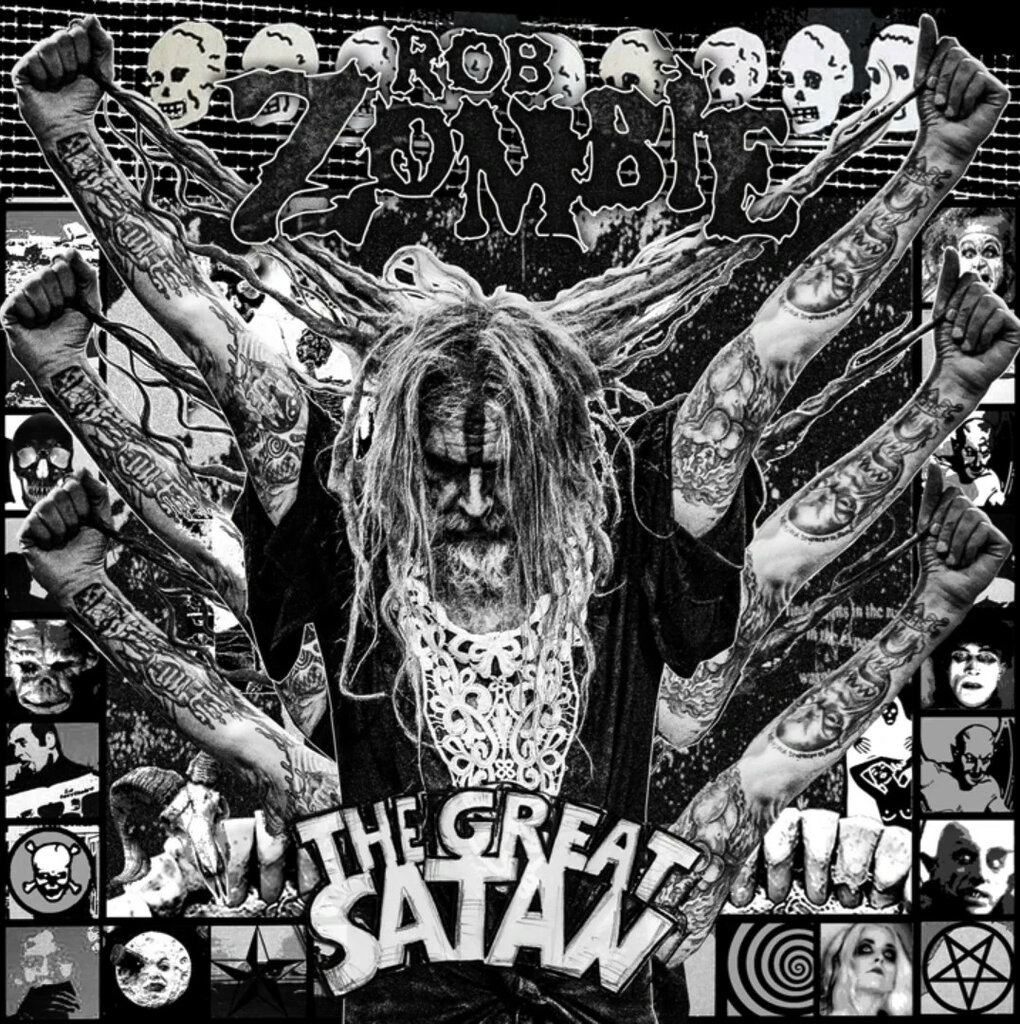
Five years separate The Great Satan from its predecessor, The Lunar Injection Kool Aid Eclipse Conspiracy. For Rob Zombie, that's a long time. Even when he was considering giving up music to devote himself to cinema, we didn't go through such a dry spell! That's the first piece of good news. For the second piece of good news, just take a quick look at the cover to see that he's ditched the long titles, which is much more practical! In recent years, after the departure of former Marilyn Manson guitarist John 5 for Mötley Crüe and bassist Piggy D for Marilyn Manson, Rob Zombie has finally reassembled the lineup from the first Hellbilly Deluxe era... with the exception of loyal drummer Ginger Fish, a former Marilyn Manson member.
But then a question arises: what can we expect from Rob Zombie in 2026? Is he that funny monster trapped in a form of nostalgia for the late 90s/early 2000s? There was a time when a direct parallel could be drawn between his albums and his films, both in terms of atmosphere (The Devil's Rejects opted for a dustier, more realistic approach than House of 1000 Corpses at a time when the album Educated Horses was ditching the makeup and costumes) and in terms of inspiration (his brilliant and unfairly despised The Lords of Salem was released at the same time as the album Venomous Rat Regeneration Vendor, a real breath of fresh air). In that case, what can we expect (or rather fear) from the musician when his films released over ten years ago are best ignored? Yet we were left with a good impression; even though the previous album was overloaded, it retained a touch of jubilant madness.
Well, surprise surprise, Rob Zombie is being Rob Zombie. Ultimately, like his recent films made on a shoestring budget, his music returns to a form of primitive modesty. Samples for a B-movie vibe and energy that goes in all directions, that's what The Great Satan has in store for us. Welcome to the 80s, the blessed era of satanic panic! F.T.W. 84 will settle any debate: either you'll get carried away by this heavy, rock ‘n’ roll, slightly punk track with Robert enthusiastically spewing out f-bombs, or you're a boring person who will nitpick that we've heard it all before. You'll be right. But you're boring. In its final moments, this first track plunges into a sinister, horrific doom that's so cool we wish the whole album was like this so we could get out our torches and do some pagan stuff. If that's your thing too, then put The Devilman on repeat, with its Grand Guignol heaviness!
There's one thing that Rob Zombie, despite his fetish for the 70s and 80s, has in common with much younger artists: his songs are short but mutate and go off in all directions. If you're in the “boring” camp, you'll find it tiring. Tarantula, a regressive pleasure, gives us another cool grand finale, like a curtain or guillotine falling. I'm a Rock'n'Roller recycles White Zombie-style gimmicks, that deviant groove, that urge to play tambourine on unmarked graves or sacrifice babies in an amusement park. Familiar but devilishly playful, Sir Lord Acid Wolfman plays the sinister crooner, like Tom Waits resurrected by a nuclear disaster... In short, as you can see, Rob Zombie pulls off his usual tricks like a carnival barker.
In this monstrous parade of odds and ends, however, there is a noticeable return to a more industrial sound. There are some nasty Ministry-style riffs on Heathen Days and Punks and Demons (incidentally, the Christ-like pose parodied here on the black-and-white cover by Rob Zombie is reminiscent of that on Al Jourgensen's band's album Rio Grande Blood... which featured a track called The Great Satan!) and fans will appreciate the Die Krupps-style percussion in the background of Black Rat Coffin. As for the rest, well, the Zombie hasn't changed his robe. He chants his choruses in his guttural voice and delivers a performance as generous as the 666 others we've seen before at other fairs. As the end approaches, the delirious circus of The Black Scorpion and the psychedelic finale of Unclean Animals and, above all, Grave Discontent bring a final smile to our faces.
The conclusion is simple: with The Great Satan, Rob Zombie leaves behind the mad scientist experiments proposed by John 5 and delivers an album full of simple pleasures. In essence, it's a return to his more satisfying “early” universe than the somewhat laborious Hellbilly Deluxe 2. Monsters, rednecks, the Devil, booze, crazy killers, big riffs, energy, crazy interludes... you know the dirty-funny formula. The Great Satan is Rob Zombie putting on a show with a sometimes enjoyable nastiness and a contagious childish glee. Admittedly, it's uneven (is it because they come late in the album that Out of Sight and Revolution Motherfuckers are struck by the terrible curse of “instant skip”?), but what Rob Zombie album isn't uneven? That's also what makes him endearing, that slightly lame, slightly grumpy-wanker side that's so entertaining.
Less avant-garde than in the 2010s, it reminds us of a line uttered in the 1990s by those great philosophers of the 90s Beavis & Butt-Head, when watching a KoRn music video: “Some music speaks to the soul and stimulates the mind... and some music speaks directly to the butt.” The Great Satan may not necessarily speak to your soul, but if you're in the mood, it will get your booty shaking.