
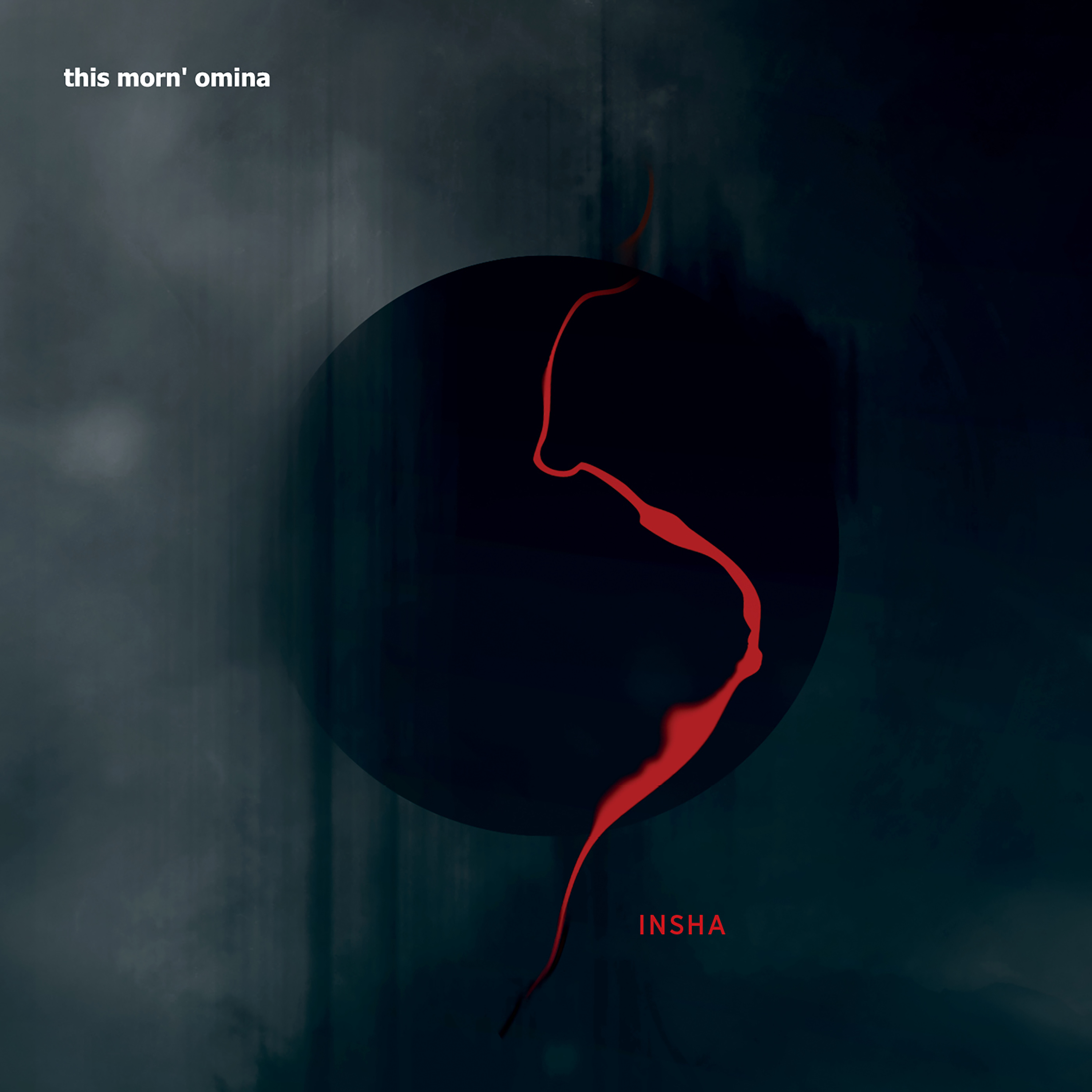
Active since 1996, This Morn' Omina is one of the enduring bands on the small scene known as “tribal-indus.” The project by Belgian artist Mika Goedrijk, supported by several live musicians, is indeed among those artists who make extensive use of ancient and non-European sounds and rhythms, blending them with influences from industrial, EBM, and techno, thus combining age-old invocations with technology. This scene was particularly developed by the German label Ant-Zen; its roots in industrial music run deep, as one can trace its origins back to SPK’s 1986 album Zamia Lehmani: Songs of Byzantine Flowers. This Morn' Omina, for its part, has long distinguished itself through the power of its rhythms, which have often delivered fierce blows, set against ritual atmospheres of great beauty. Now on the labels Cyclic Law and Zazen Sounds, This Morn' Omina presented us in February with their first album since The Roots of Saraswati, released in 2021: Insha, the Latin alphabet transcription of the Arabic term إنشاء, meaning creation or construction. So what has This Morn' Omina built this time?
Insha is a somewhat unique album in This Morn' Omina’s discography because, this time, Mika Goedrijk worked on his compositions in close collaboration with Nam-Khar, a dark ambient artist who has also performed alongside Sielwolf—a band for whom the “industrial” in “industrial metal” wasn’t just for show. The fact is, Insha has another distinctive feature that surely explains the collaboration with Nam-Khar: this record is among the band’s most ambient works, with slower tempos and beats that are far less brutal than the barrage of beats we’ve experienced on This Morn’ Omina’s more rhythmically industrial-oriented albums, particularly among their most recent releases. On the other hand, it’s always a pleasure to rediscover that mix of hypnotic percussion rhythms that carry us far away through time and space, along with varied samples and machine-generated sounds—a trademark of This Morn’ Omina since their debut.
Another recurring feature is the wide range of references drawn upon by the album: while some of the themes evoked by the track titles lead us—as is often the case with This Morn' Omina—to India (the Sanskrit name Mañjuśrī refers to Buddhism, and Nalanda takes its name from a city in northern India that was home to a Buddhist university, while the Sanskrit term Sannyasin is a concept drawn from Hinduism), others take us to Egypt (7Sekhem draws on the ancient Egyptian concept of the life force), in addition to the album’s Arabic title; what interests Mika Goedrijk is not focusing on a particular cultural tradition but rather echoing the beauty created by humanity in general. On Insha, more specifically, This Morn’ Omina aims to directly explore the sources that lead to creation in general, by grasping the mechanisms that allow for “the emergence of ritual, intention, and matter” in their own words.
This Morn' Omina shows us this emergence of creativity, which first arises as a distant call and then becomes an obsession: the first two tracks, Heralds and Tephra thus begin with carefully crafted atmospheres, built from various sounds and synthetic layers, amidst which a repeated sound calls out to us; the rhythm created by the electronic loop then takes center stage on Heralds as the atmosphere grows darker, like an irreversible shift, while Tephra remains calmer; the distant tinkling and clacking that draw our attention seem to recede as we follow them. These impressions are the result of a beautiful sonic depth: on Insha it is clear that the sounds are not all on the same plane thanks to variations in volume, creating a sort of soundscape in which we move.
The following tracks prove that gentle tempos don’t prevent the rhythms from being striking; electronic loops and percussion dominate most of the tracks with their relentless repetition, surrounded by a variety of samples. After all, creation isn’t just about inspiration—it’s also about hard work! Each of these tracks has its own distinct atmosphere and sound, giving the album great depth. Mañjuśrī strikes us as the most beautiful: the interweaving of rhythms and sounds, with the female vocals dancing around the percussion, is hypnotic and wonderful. Human vocals are rare in the world of This Morn’ Omina, where instruments and sounds are more often used as a direct language of the soul, but they reappear on Body of Light where the gradually enriching electronics seem to herald an elevation beyond earthly burdens at the end of the creative process.
Insha is, therefore, a surprising album—not because of its richness or power, since This Morn' Omina has already had a long career marked by fascinating albums, but because of its shift toward a much more ambient sound without losing its penchant for pounding rhythms. While the album isn’t particularly cold, the band remains true in this new incarnation to the elements we cherish in industrial music: the structure of the tracks doesn’t follow pre-established patterns but has its own discipline; there are no limits to what can be used as a sound or which sounds can be combined; the music conveys ideas that transcend it. We don’t know if it’s possible to fully grasp creation as such, but this particular creation is highly recommended!