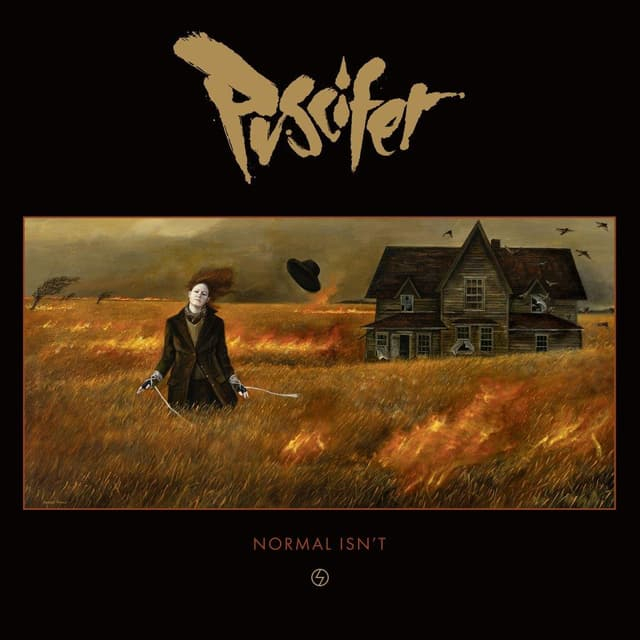
With Conditions of my Parole in 2011, his second album, Puscifer earned his stripes and moved away from being a recreational side project serving as a pretext for Maynard James Keenan's dirty jokes. This gem of elegance and inventiveness certainly allowed Puscifer to better define its identity and solidify itself around the trio completed by Carina Round and Mat Mitchell, with melancholy, often contemplative but not without theatricality and irony... but it also marked the beginning of a kind of routine: it's perfectly reasonable to find Puscifer vaguely predictable, a tad pompous, even pretentious, despite occasional flashes of genius. And then came Normal Isn't, the fifth studio album in a discography full of remixes, live recordings and other things that don't help to make sense of it all.
Normal Isn't feels like a reunion album. It's not with the precision and subtlety of Puscifer that we are reuniting, since we never lost sight of. What we do reunite with is that thrill, that pleasure, that surprise: from Thrust and its contained tension, as Keenan and Round's voices respond to each other, something happens. A threatening darkness, a heaviness just waiting to be released: you can sense that something dramatic is about to happen. MJK, cryptic and disturbing, enchants with his usual grace but also with an extra dose of rage that we are delighted to rediscover: listen to him roar on A Public Stoning or the excellent Mantastic, with clinically cold percussion that would not be out of place on a Nine Inch Nails album.
The Tool singer warned us: Normal Isn't is an album in which he pays tribute to his goth and punk influences. There's a touch of Depeche Mode in there (the impeccable ImpetuoUs and its discreet yet masterful build-up to an almost industrial finale) and a Sisters of Mercy-esque fog (the drum machine, the mystical atmosphere and the hit-worthy approach of Pendulum). The result is denser and, with its guitars brought to the fore, more catchy than on previous albums. The music is more visceral, more haunting.
From this succession of rituals, sometimes cathartic, sometimes hallucinatory, emerges the delightful impression that Puscifer is, more than ever, a crazy and liberating musical laboratory. More uninhibited, more direct but no less rich, the album is imbued with an appetite for creation whose vivacity is fuelled by sincere rage. In Self Evident, Maynard James Keenan accuses: ‘you're a bunghole’. He explained, "As storytellers and artists, our job is to observe, interpret, and report. We take in our environment and share what we see, and what we see around us does not appear normal. Not by a long shot". Irony, though still present, gives way to a more explicit anger than in the past, creating a palpable pre-apocalyptic atmosphere.
Ending with a live version of The Algorithm, which is amusing but somewhat out of place (although its social media commentary easily links it to the themes ofl Normal Isn't), Seven One can be considered the true finale of the album. Narrated by Ian Ross, Atticus's (NIN) father, and tormented by the drumming of the brilliant Danny Carrey (Tool), this edgy and cryptic conclusion completes this fifth album, making it a monster in its own right. Puscifer is inspired, incisive and consistent from start to finish (has this ever happened before, except perhaps in 2011?). Darker, more spontaneous, less captivated by its own navel, without forgetting to remain playful and eccentric, Normal Isn't is not only Puscifer's best album, but also the most striking proof that today, after so many years of searching themselves, the band can no longer be seen as just ‘the side project of the guy from Tool’, but rather as an exciting entity in its own right, still capable of reinventing itself.