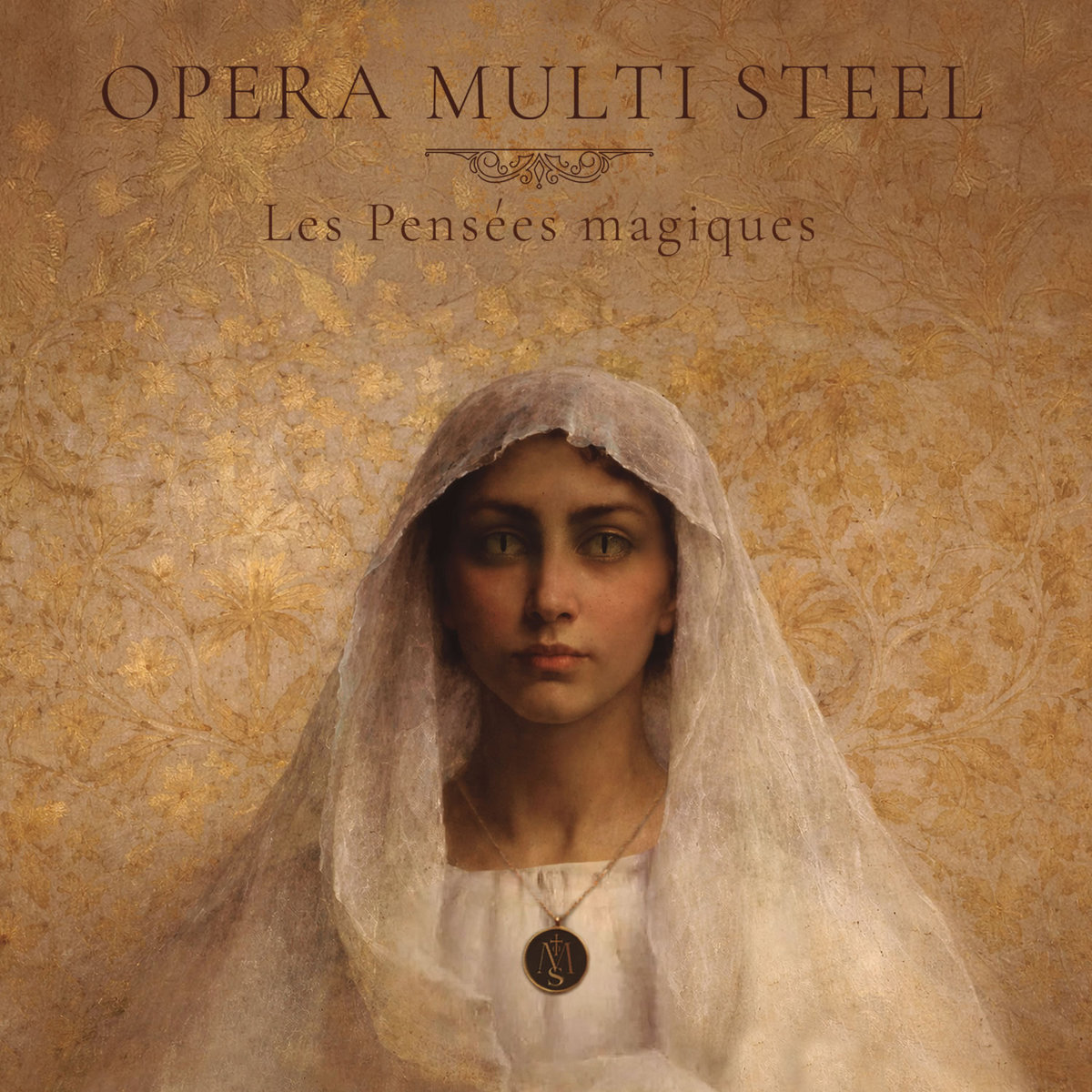
We really enjoyed Opera Multi Steel’s album Les Passions tristes three years ago (review), which teetered on the brink of an emotional precipice with the band’s unique blend of synthpop, coldwave influences and medieval folk. This year, the trio presents its follow-up: Les Pensées magiques. We’re keen to give it another go, especially as the cover is once again beautiful and unsettling – this time a reproduction of a painting by Étienne Azambre, held at the Sens Fine Art Museum, modified by the Brazilian artist Hernan Czauski.
Following Les Passions tristes, Opera Multi Steel explores another aspect of the human psyche: the escape into magical thinking, the return to the irrational, driven by a tension arising from the confrontation with disillusionment. The theme is different from, yet complementary to, that of the previous album, and so is the album’s structure: appealing more to reason than to the unconscious, Les Pensées magiques is a less danceable and more linear album; the drum machine takes a back seat to synth pads, and the tracks gradually gain in intensity whilst delving deeper into the strange as unexpected sounds emerge through a painstaking process of sound collage.
As ever with Opera Multi Steel, whose career now spans more than four decades, the album’s soundscape is both profound and unique. The band knows how to play with the different layers of their music, blending – with a magic all of their own – analogue electronic sounds, flutes and acoustic guitar, Patrick L. Robin’s vocals with their liturgical or medieval overtones, whispered interludes from Catherine Marie’s voice and surprising samples, whilst enveloping us in reverb. The result here is even more disconcerting than usual: the way the sounds emerge and dissolve, the repetitive patterns in which the keyboard becomes locked, and the drawn-out vowels in the vocals give us the impression of sinking into a sort of delirium that is not unpleasant, but whose illusory nature is strikingly apparent to the ear.
Once again, it is well thought out and deserves a careful listen; however, we must admit that we were more taken with Les Passions tristes: the more linear structures and static rhythms of Les Pensées magiques are less compelling and, due to their deliberately elusive nature, leave less of a lasting impression on the mind, so that one sometimes finds the album a little too long, even though it is in fact barely any longer than the previous two. We are nonetheless fascinated by these strange melodies and are particularly drawn to the tracks that give greater scope to dramatic intensity – Dimensions nouvelles, Aux Abords des Eaux froides and, even more so, Démarcation. However, it is something other than these tracks taken individually that we remember most about Les Pensées magiques: the impression of a disquieting album, where what is reassuring is unreal and where we never quite manage to make sense of everything around us; having returned from these magical thoughts, we are left with little choice but to accept reality.