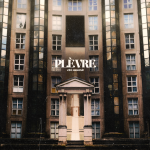

What? A purple cover featuring neon lights? No imagery linked to 20th-century totalitarian regimes? No covers? No cryptic references to fascism? Music that claims to be influenced by Eurodance, J-pop and K-pop? What on earth is happening to Laibach?
The album Musick, which marks the start of a new era for the Slovenian band this year, is certainly a surprise. One suspects they’ve carefully planned their move to catch us off guard once again – and they’ve succeeded. Whilst the band has been extremely prolific in recent years, Musick is nonetheless their first album consisting entirely of original songs since the excellent Spectre, back in 2014, making it a particularly significant release. There is, of course, an approach, which Laibach presents as follows: this time, the Slovenian band takes as its subject the saturation of music in our society, its standardised production designed for instant appeal, its manipulation by modern technologies —particularly artificial intelligence— and the way it is filtered by the algorithms that guide our searches; a desirable and perhaps even indispensable commodity that we are bombarded with to the point of overdose, like so many other things in our societies. For those who might cringe at the sight of Laibach releasing a resolutely pop album, we would remind you that the band has produced some fine industrial tracks in recent years with Wir Sind Das Volk! (review) and, even more so, Sketches of the Red Districts (review).
That said, whilst the approach is intriguing, there are grounds for some concern: Laibach has already dabbled in pop with the cover album The Sound of Music (review), but the result struggled to rise above the level of a good joke and make a lasting musical impact. What will happen this time?
Rest assured: Musick is not only very funny but, above all, highly effective. To mimic contemporary pop, Laibach has pulled out all the stops: danceable beats, cheerful and catchy choruses, several guest vocalists from the pop scene alongside Marina Mårtensson, structures that become increasingly repetitive as the track progresses, and autotune; all whilst continuing to make use of analogue synthesisers. To our great surprise, we find ourselves happily swept along! There are two reasons for this success: on the one hand, the genres Laibach appropriates here are more danceable than the innocent sweetness of The Sound of Music; on the other hand, Laibach has gone further this time by fully embracing the conventions of Eurodance, K-pop and J-pop to produce an over-the-top version rather than simply mocking them.
For Laibach, essentially, is doing nothing here other than applying to pop music the strategy of hyper-identification that it applied to nationalist propaganda in the 1980s: dissecting the characteristics of the phenomenon under study to create a sort of distillation, an overloaded version of which it is no longer clear whether it is an extreme form or a parody. As always, the technique reaches its peak in the music videos: Allgorythm and Musick are both funny and striking in the way they distil the aesthetics of the buzz, as well as being irresistible. On these tracks, Laibach takes the elements that make pop hits successful whilst adding a dramatic intensity all of its own, all with Milan Fras’s bass voice! One can be swept along by them just as one might have been swept along by the raw power of Geburt Einer Nation; mockery does not prevent their hold. The case of Fluid Emancipation is unique: the lyrics here consist of the exhortations to relax, enjoy the moment and abandon all reflection that the tech and entertainment giants hammer home to us, creating an illusion of freedom; but as he states in his newsletter, the band also questions the individual’s ability to truly free themselves from constraints through social struggle, to transcend the expectations imposed by class, gender and sexuality, as shown by the images in the video, most of which are taken from the Slovenian-Macedonian film Fantasy (due for release in France in October 2026) – unless I am mistaken, this theme is a first for Laibach!
Whilst Allgorythm (which Milan pronounces AllGoRythm), Musick and Fluid Emancipation are particularly effective pop anthems to which Laibach imposes its dictatorial grandiloquence (you can’t change who you are), the first two further bolstered by the impressive energy of Ghanaian singer Wiyaala, other tracks win us over in a different way: Singularity, which brilliantly butchers the melody of Mozart’s Eine kleine Nachtmusik; Love Machine with its Far Eastern sample that makes you want (in French) to write it as Love MaChine; and above all the formidable Luigi Mangione, named after the American criminal who sparked a wave of sympathy by murdering the CEO of an insurance company specialising in health speculation, presents us with a wonderfully heavy Western atmosphere with his acoustic guitar and whistling, whilst the lyrics (incomplete in the booklet) evoke the various movements that have been clashing in the public sphere in recent years... This is no laughing matter: it’s sinister, and it’s the best track on the album.
As we can see, Musick is far from merely mocking pop music; on this album, Laibach has succeeded in subverting the conventions that shape the music accepted by the mass media, drawing from them a unique power.