Primordial Black aren’t wasting any time! The Tunisian band released their debut album, Dark Matter Manifesto, less than a year ago. Given their rich soundscape—where extreme metal draws on industrial atmospheres and numerous cinematic and literary references—it’s surprising to see such a short turnaround. And yet, Primordial Black has clearly taken the time to engage in a form of introspection, viewing their music from a new, more avant-garde and non-euclidian angle. This sounds promising!
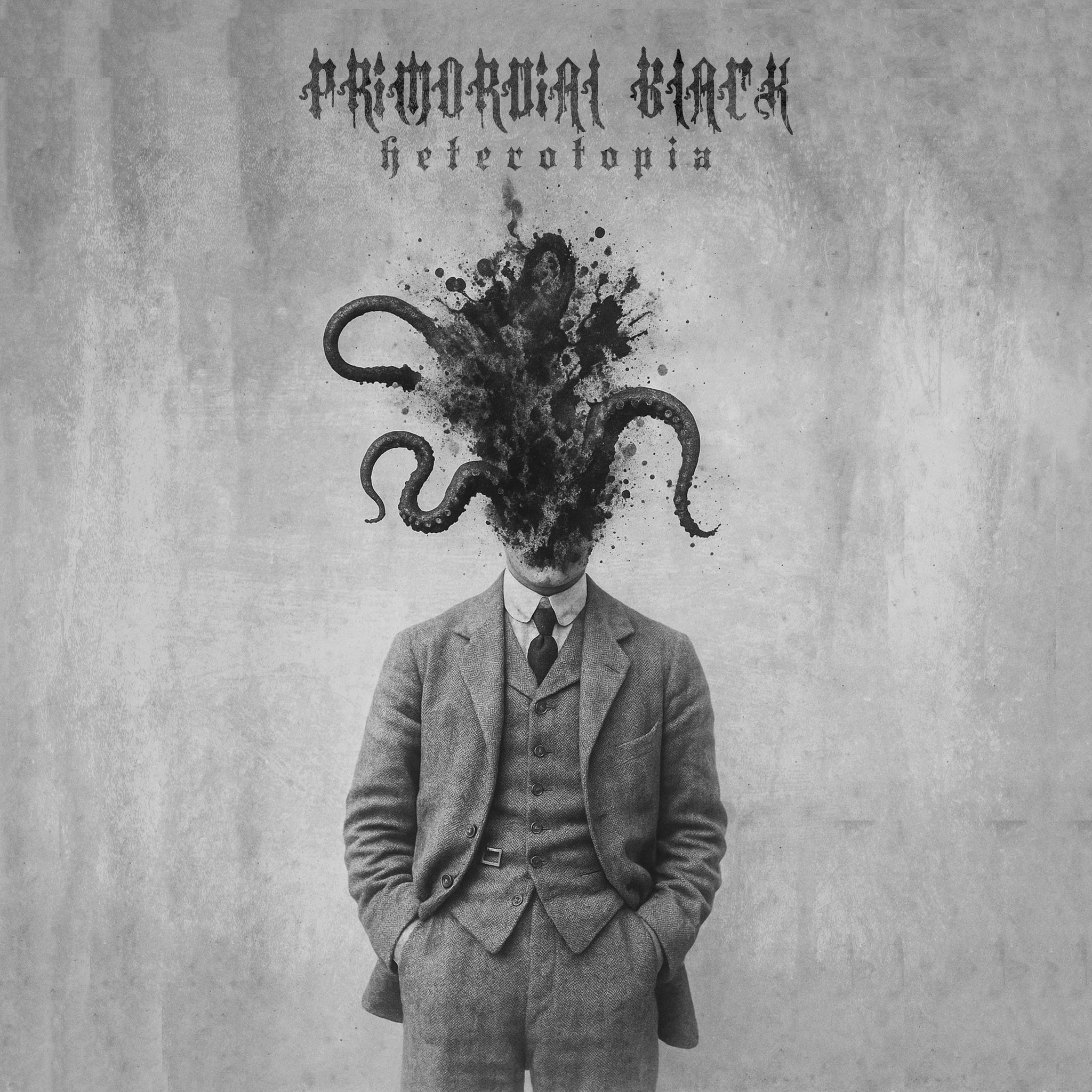
The first point of contact with Heterotopia is, of course, the artwork: following Gustave Doré on the previous album, this time it is created by singer and guitarist Yasser Mahammedi-Bouzina and already introduces the band’s world with a distinct taste for the Gothic and Lovecraftian tentacles that seem to fill the subject’s mind... This certainly smacks of madness, dark visions and secrets whispered in the dark! Primordial Black pays close attention to detail and takes the time to immerse us in its nightmare, with Caos Guidato serving as the gateway. Ghostly synth swathes, guttural throat-singing, a bell with a sinister echo and the breath of the wind – that’s all it takes to set a sombre and mysterious, even mystical, scene.
If there’s one area where Primordial Black has really focused their efforts, it’s the atmosphere. The compositions have gained in scope, dynamism and ambition, and the whole thing breathes thanks to contemplative pauses that add real depth (right from the start, the pause in Ruines Suspendues allows the listener to immerse themselves whilst also making the violence seem tenfold, Primordial Black having clearly understood that it’s all about contrasts and nuances). We then revel in the sinister piano that opens the track Heterotopia before grandiloquent choirs come to haunt it, the sudden cut in the middle of Mater Suspiriorum and its clear vocals as surprising as they are welcome (savour the echo of the drums, cutting through that deathly silence, when they kick in again!), the crackling of Immaculate that transports us back to a bygone era of exploring forbidden secrets and fateful discoveries, the misty brass of Begotten accompanying Camilia Bayazi’s voice in a break that David Lynch himself would not have disowned, or the ticking of the clock and the whispers that overlap in Le Horla, evoking a creeping madness before a melancholic finale... This non-exhaustive list illustrates how Primordial Black seeks to offer fresh ideas on every track, demonstrating a genuine care in bringing the worlds they conjure to life.
If you’re a fan of horror cinema or fantasy litterature, you’ll no doubt have noticed that certain worlds are evoked, justifying particular choices in sound design or approach. Dario Argento’s Three Mothers continue to lurk in the shadows: shall we bet that, in the future, a track will be titled Mater Tenebrarum? The paranoia and self-annihilation that seep from Le Horla or the surreal strangeness of Begotten aptly capture the spirit of the works to which the tracks refer. All of this contributes to creating an overall mystical atmosphere, something between a dark secret ritual dedicated to malevolent deities that defy both reason and our senses, and a funeral procession.
Of course, put like that, one could almost forget how Primordial Black takes a wicked pleasure in crushing us, making us feel tiny. Rest assured: Heterotopia packs a massive punch and knows how to be ruthless, conquering, and savage. Just listen to the incantations of‘Immaculate, featuring Death's Steve DiGiorgio on bass, to convince yourself: here lies the raw material for a blockbuster of extreme music—spectacular, dark, grandiose—a monstrous thing of cyclopean proportions and angles that defy logic. To put it more succinctly: certainly, Primordial Black speaks to our damned souls but also to our bodies with visceral, snarling and vicious music just the way we like it. We already had a strong sense of this penchant for off-the-beaten-track paths on their previous album, and it’s a pleasure to hear them fully embrace their more atmospheric, dissonant and unpredictable tendencies. This sense of excess does not detract from elegance or subtlety, and we find all of this in Heterotopia, a monstrous album in every sense of the word, generous and one that we contemplate with the same fascination as the advent of an apocalyptic entity.