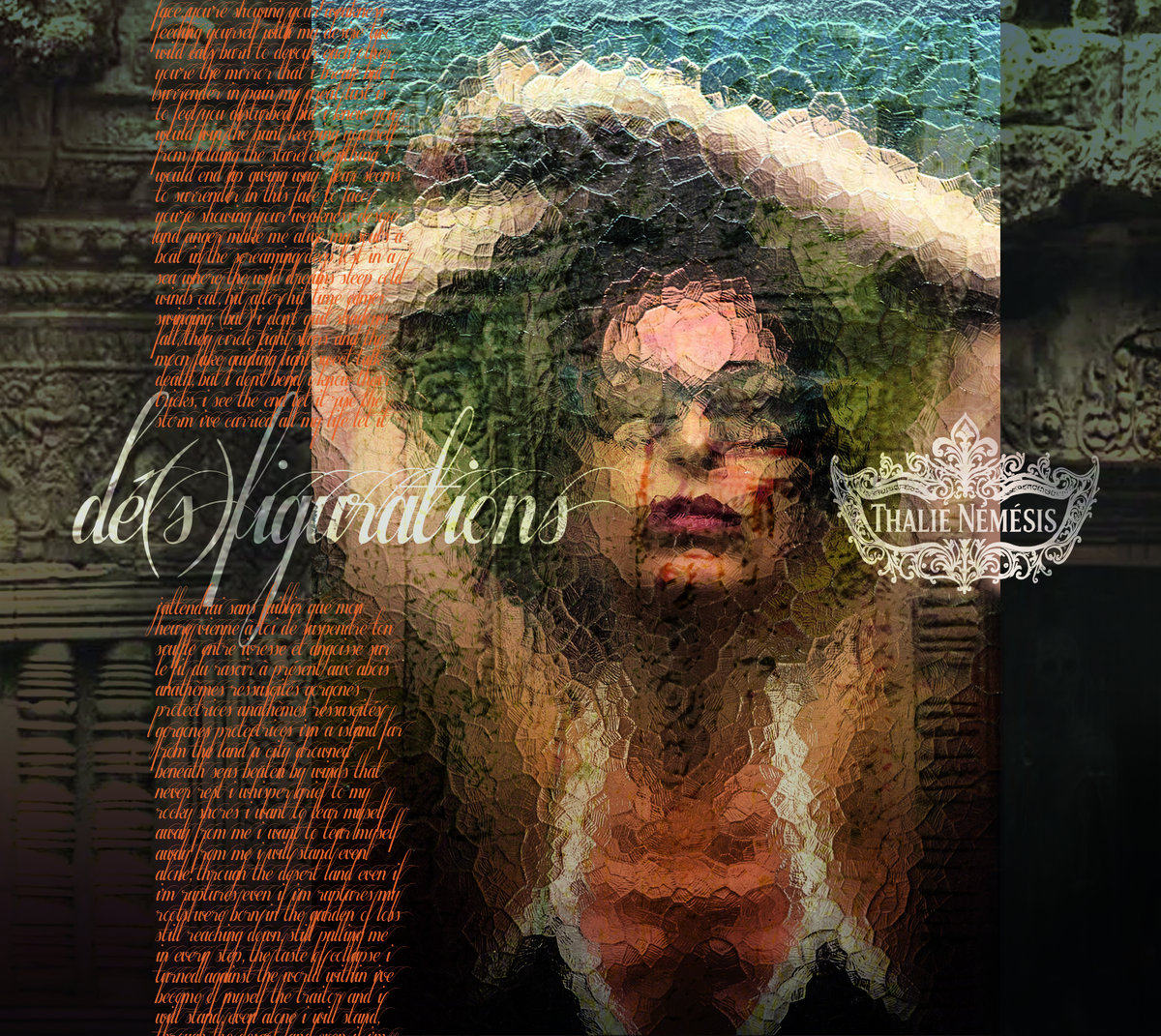
An air of mystery surrounds Dé(s)figurations, which comes ten years after its predecessor Némésis, Thalie Némésis’s only album before now. Just like the portrait on the album artwork, which seems to elude us behind her dark glasses and a texture that’s halfway between a pane of glass and the cracks in a canvas, Thalie Némésis appears to be both searching for herself and skilfully evading any easy categorisation. Darkwave? Industrial rock? A hint of cold wave? Yes, there’s a bit of all that, and labels don’t really matter! You immerse yourself in it as if entering a timeless maze shrouded in mist: without really knowing what you’ll encounter along the way, or who you’ll be by the time you emerge – if you emerge at all.
Over the past ten years, Thalie Némésis has collaborated with other artists, notably Phil K (AinSoPhaur) on the K/N project. She has gained a wealth of experience and her voice has become more assertive, something that is evident from A Barbaric Language onwards. Her vocals are more confident than in 2014, of course, but the sound has become denser, notably featuring some heavy, distorted guitars that add a new sense of tension. Eastern and ancient influences, a taste for ritual incantations, mystery, electronic turmoil interwoven with traditional sounds, Gothic solemnity… Thalis Némésis evokes the spirits of late-90s Nine Inch Nails just as much as those of Zola Jesus or Bestial Mouths.
Dé(s)figurations blends influences, languages and eras. Ultimately, all of this seems to echo a quest for identity, with the music reflecting the artist’s questions (in this respect, the hypnotic closing track Forget My Name resonates like a natural continuity of the questions that have haunted the album since A Demi-Mots). Thalie Némésis invites us to lose ourselves alongside her in her wanderings, her mysterious personal labyrinth woven from nuances, mythological figures (Nemesis and Cassandra, for example, two strong female figures), mysticism and restrained emotions that build up with restraint. For example, Ruptures, with its ghostly backing vocals and industrial tension that eventually explodes, is a fine achievement, flirting with metal aggression without quite succumbing to it, keeping Thalie Némésis in a liminal space all her own, where doubts go hand in hand with a powerful musical confidence.
The rage is contained, channelled, and blends with melancholy to give life to a succession of intriguing, fascinating spells (the haunting Defixiones, in collaboration with Eva|3, which here alludes to the curse tablets of antiquity). The album thus displays an elegant intensity and theatricality, without excess or over-the-top dramatics, but with visceral expressiveness, skilfully controlled tension and a mastery of atmosphere that crafts mirages which we almost grasp but which continue to elude us.
With rigour, poetry and subtlety, Thalie Némésis imbues her intimate themes with a sense of timeless magic – or perhaps it is the other way round. In an almost alchemical balance, musical exploration and variety complement the melodies that hit the mark, with tracks that grab your attention and are enriched by unexpected, ever-changing sonic turbulence (the atmospheric No Surrender or the more rock-oriented Face to Face – Wild Horses are just as adept at embedding themselves in our ears thanks to their flair for the catchy phrase as they are at appropriating those very phrases to make them their own). It is as ambitious as it is captivating. Will we find the centre of the labyrinth alongside the artist? Let’s hope not, for the quest is ultimately far more thrilling; let’s linger here a while, listening to her omens, hoping that our name isn’t nailed to one of her tablets of defixion!