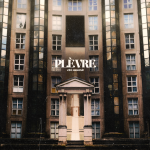

Léa Jacta Est's second album comes as a surprise, firstly because, following a debut album that took quite a long time to come to fruition, we weren’t expecting a second one so soon… but above all because its content is so surprising! Haematomancy refers to the study or use of blood for magical purposes, but also, as the artist explains, ‘divination through wounds’. hémantomancie is also the title of her new album, a wound that takes us far from the sunny, fantastical horizons of her debut’s imagery.
This time, it took just two weeks for hématomancie to come to life. Which direction the project would take, having started out as minimalist folk—just guitar and vocals—and gradually evolved into a hybrid blend of pop, noise, psychedelic folk and gothic folk? Was Léa Jacta Est heading towards a more demonstrative, more ‘spectacular’ sound, set to become a grandiose, dazzling summer blockbuster? Let’s not rule it out: one day, perhaps. But not today.
Very quickly, hématomancie sets its hushed, intimate tone. A recitation played backwards, foreshadowing the tracks to come, serves as an introduction before cyclone introduces us to new witch-house and industrial influences. Amidst these sounds, the lyrics are simple, chanted and repeated like an incantation, yet without effusion – an internal, contained storm, a constant tease that keeps the listener captivated. We fall silent and listen. The atmosphere is dark and oppressive. Whilst Léa Jacta Est still harbours the same fascination for the trivial details of everyday life and finds a form of beauty where one least expects it (that Flixbus mentioned in iris or that cover of Moos’s aunomdelarose which, stripped of its hit-song format, allows us to question its lyrics), hématomancie doesn’t really delve into the humorous incongruity of gentle absurdity as some of the artists's previous works.
Darkwave, noise, ambient, shoegaze: whatever the labels, Léa Jacta Est’s music has taken on an incantatory quality, yet without any over-the-top theatrics (despite those percussion parts with their sinister, theatrical echo that really pack a punch on salive!), the rituals here are atmospheric and personal, the sort of magic we practise in the privacy of our bedroom in the middle of a lonely night. Even the organ knows how to keep a low profile, for example during the hypnotic, twilight-like ombredusépulcre – a moment of industrial, gothic and hallucinatory trip-hop where Léa Jacta Est sets the spectres of Portishead, Massive Attack and Anna Von Hausswolff dancing. The result is a sense of constant menace and anxiety, of unease in which her noise-based experiments are like painful eruptions, distortions of reality. Keen to “set her grief to music without slipping into self-indulgence”, as she puts it, she blends sincerity and modesty with a precision that transforms her torments into universal poetry (the sort of expiatory nursery rhyme that is fleurdepunition), drawing us in with the tone of a private confidence.
Despite its sombre mood, hématomancie manages to strike a graceful new balance between its fascination with mysteries – whether personal or cosmic – and its ever-present romanticism. Musically, Léa Jacta Est reaffirms, amidst guitar echoes creeping like mirages, her penchant for experimentation and her refusal to stagnate. In this respect, the album is as much the product of her anguish as of her musical explorations—an alchemical Frankenstein’s monster born of suffering as much as tinkering. A spontaneous and relatively short work, this second album is a delightfully masterful balancing act in which spilled blood and visceral pain are transformed into a light, spectral beauty, and whose elegant restraint only serves to heighten its impact tenfold.