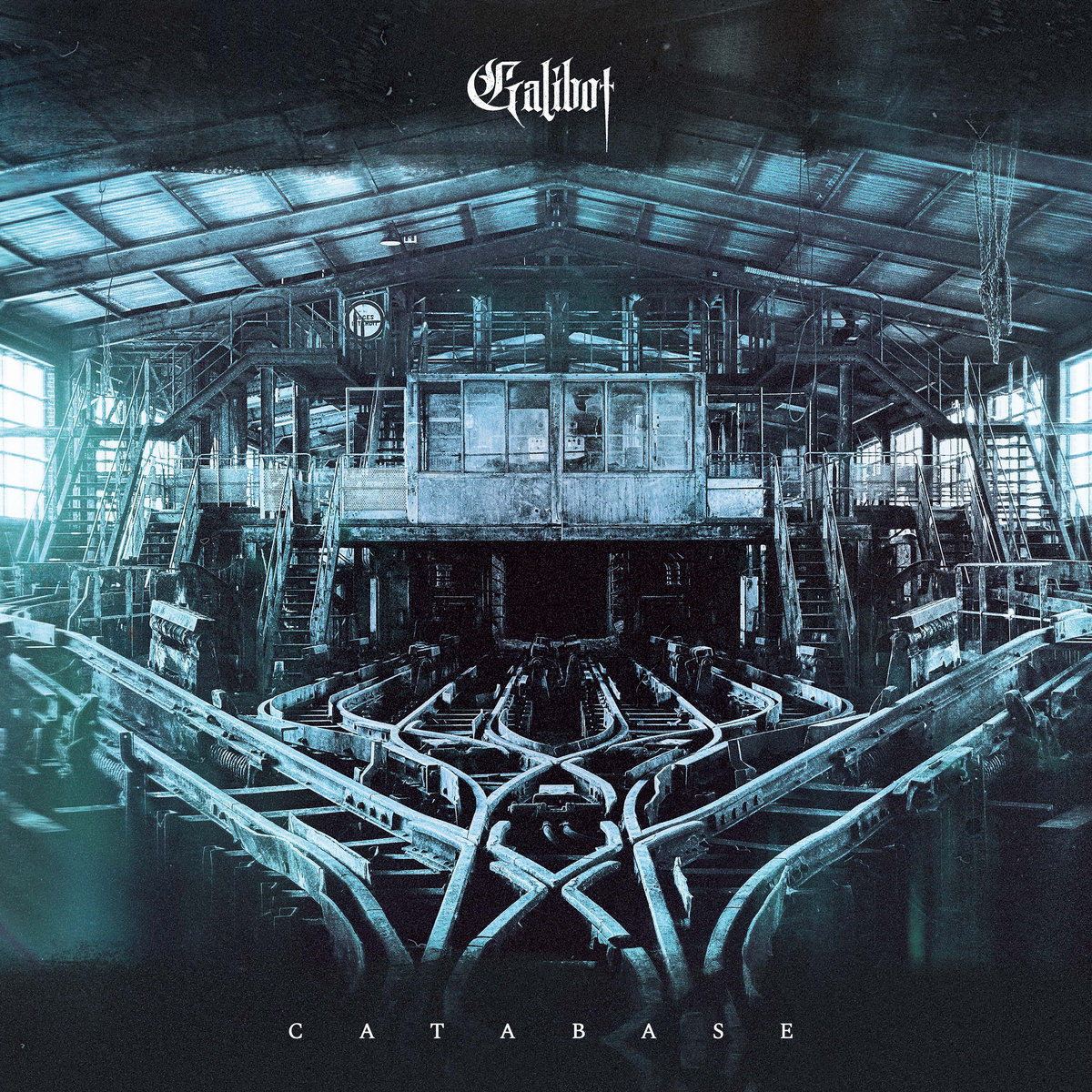
It was clear that something was afoot with Galibot, whose excellent EP Euch'mau Noir was given a re-recorded version featuring new tracks earlier this year, effectively serving as their “debut album”… just before Catabase was released. The universe is distinct and evocative: the Galibots are the children who were sent to work in the mines of northern France. The underground hell, the coal, the earth, all these eovcations of the North: Galibot has a theme that works, the blackness of coal lending itself well to black metal, whilst the mines take the place of the traditional underworld. Catabase delves (huhu) into this idea: in mythology, the catabasis refers to the hero’s descent into the Underworld...
One thing is immediately apparent from the title track, which serves as an introduction to this mining-themed world, where the sound design reinforces the industrial oppression: Galibot have the knack. They have a knack for delivering black metal that’s rich in ideas yet concise, with short tracks that all work, a sense of ‘song’ if you like. It hooks you in, it grooves, it hits hard, the riffs are brutal. The trio now plays as a five-piece, and the sound has gained in scope and power. The frenzied Jeanlin, a reference to the galibot from Germinal, pounces on us with claws out. Diffamie’s vocals, visceral and snarling (the rare moments of clean singing are as hard-hitting as pickaxe blows), the haunting guitar melodies, the alienating rhythm section: Galibot is possessed and draws us irresistibly underground.
Often, when the hero finds himself underground, it is so that he might better find himself, the darkness serving to symbolise an inner journey. There, in the darkness, one could say that Galibot has indeed found itself. The identity is strong, and this realistic setting—evocative of grey and black landscapes—does not preclude a certain theatricality (Voreux, a term referring to the mine, this devouring monster, and which, once again, recalls Zola, the weightiness of Les Montagnes Poussent Sous Terre and its chanted, spat-out words) that serves to highlight and make this entire world palpable. We should also mention the care taken with the texts and how Galibot skilfully blends its mining world with mythological or religious connotations (the pun ‘Baptise Terre’, where "baptise earth" sounds like "baptistery", or Mesektet which may well sound like the name of a Flemish beer, but it is the boat with which Rê crosses the realm of the dead at night), and how a form of poetry blossoms amidst all this clamour. Revolt is brewing in the Estaminet!
Catabase both overwhelms and exhilarates us with its energy and wild pace. It has the scope of an epic tale, yet one to which a concrete, social rage is grafted, lending reality to the poetry and symbols. Galibot masterfully captures the nuances in both content and form, balancing their love for their region with a condemnation of his workers’ suffering, biting ferocity with a sense of melody. The slag heaps become Mount Olympus; there is no longer really a sky; the album smells of rust and earth. With Galibot, the theme is not a mere artificial gimmick but something authentic and sincere. Above all, it does not serve as a fig leaf nor does it overshadow what matters most: Catabase is a sequence of tracks of formidable impact where form and content feed off one another.