
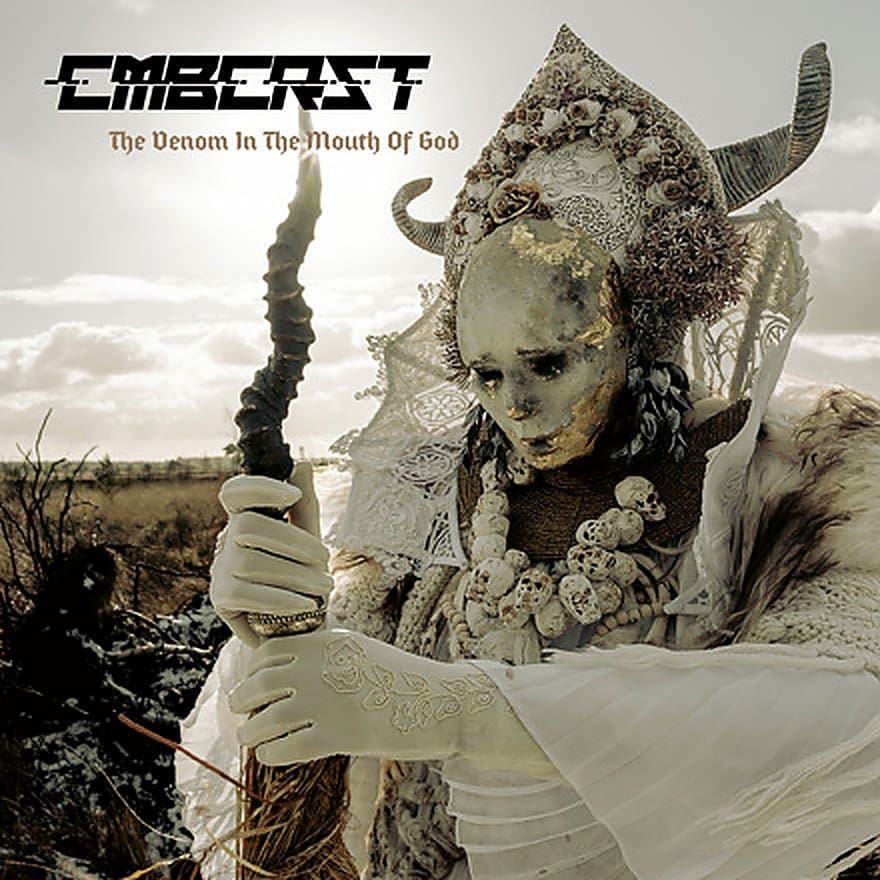
Over the last twenty years or so, Combichrist have mutated, expanded, deviated… and even grown up, maturing in a way until they found a kind of balance (in their own way) since One Fire. Their slightly daft provocations disappeared as they refined their blend of metal and electronica, as always punctiated by occasional bizarre experiment. Two years after a somewhat messy CMBCRST (as usual!) that lacked a bit of direction – and which was delayed due to the pandemic – Combichrist are back with The Venom in the Mouth of God. Let’s not kid ourselves: we’re diving straight in, foam at the mouth, salivating in anticipation of the Australopithecus-style mosh pits that await us, and with an unapologetic appetite for the choruses to bellow along to whilst the bass thumps away at full volume.
Something happens, however, right from ODR, the opening track, which is all about heaviness. Andy LaPlegua and his mates seem to hold back a storm of concrete blocks, transforming themselves into a slow, massive, menacing and ruthless bulldozer. A heavy, martial rhythm section, lurking guitars, a few guttural growls: the sound is apocalyptic. We don’t realise it yet, but it sets the tone for the rest of the album: a dark, almost depressing, vicious, fatalistic mid-tempo. If you’ve come to party, with a bottle of cheap bourbon in each hand, and to bellow out dumb slogans, you’re in for a disappointment. Desolation confirms it: LaPlegua transforms into a narrator of global collapse and plunges us into the ruins whilst looking back at his own past; he draws just as much from the early days of his project as from the ashes of Icon of Coil – with echoes of EBM, futurepop and Techno Body Music, whilst the guitars fade into the background. He tells us: “This track is a funeral rite for our planet.” The Future is a Memory confirms this; LaPlegua’s clear vocals—expressive and theatrical without being over the top—infuse the mechanical structures with enough emotion to make them feel alive and visceral.
Let's spare you the list. The evidence just keeps piling up: with this album, Combichrist are in a foul mood and plunge us into the most cohesive body of work of their career. No shimmering unicorns, no pirate songs, no B-movie satanic invocations – just a relentless steamroller. With a mix that gives equal prominence to both their most electronic impulses and their metal side, Combichrist bare their teeth and get you shaking your booty… but also seem to be in control, keeping themselves in check. Too tame? You be the judge. If Andy LaPlegua’s clean vocals bore you, if you want screams, weird stuff, things to go absolutely wild like bonobos, well, go back and listen to their albums from the early 2000s!
One might also argue that, in this approach, Combichrist offers no surprises. The tracks, all unstoppably effective, follow one another in quick succession and rarely stray from their set course. To the point of seeing them as a formulaic clone, sandwiched between the big names of the NDH and EBM/synthpop scenes? Let’s not get carried away. The contrast between Venom’s riffs and his more atmospheric layers, verging on the mystical, to which LaPlegua’s lines—steeped in desperate madness—add depth; the melancholy that oozes danger in the chorus of Only Here for a Good Time; the hypnotic, serpentine loops à la 3TEETH on Demons Wanna Be Summoned featuring KING810… the album has its fair share of rough edges, raw emotion and grit.
For the first time in their discography, Combichrist have released an album on which no track serves as a low or some weird and exciting (or slightly embarassing) oddities. Here, every track is a potential single. Staying true to their approach of recent years, the band blends their different eras and aspirations (the influence of Icon of Coil hasn’t been this prominent for a long time), right up to the epic finale Second Ending (We Have Been Here Before), a blend of EBM and pessimistic futurepop where the guitars gradually take hold. Combichrist lets an overwhelming bitterness and nostalgia for a doomed world take hold. It all works very well, haunted by the emotions conveyed as much by LaPlegua’s performance as by the way the guitars explode at just the right moment.
You’re perfectly entitled to think this is Combichrist’s best album, the most focused – the least 'Dumbichrist', the most 'Gloomichrist' If you lost interest with One Fire, you’re also perfectly entitled to think this is their worst. If you’ve lost interest over the last 20 years, you won’t even give it a listen. In any case, The Venom in the Mouth of God is what most closely resembles Combichrist’s live sound at the moment. The band seem to have refocused; they’re less all over the place. In the past, we’ve regularly glimpsed Combichrist’s more human and personal side: here, it’s ever-present. Yeah, well, that’s a lot of words, but don’t worry too much: it’s not some pretentious avant-garde poetry either; if you want to smash stuff up, this works just as well.